CEFR Self-Assessment Guide: Find Your English Level in 10 Minutes
The CEFR scale is the most useful map of English proficiency we have, but most online level tests are too short to be honest. Use this can-do checklist before you book a placement test or pay for any course at the wrong level.
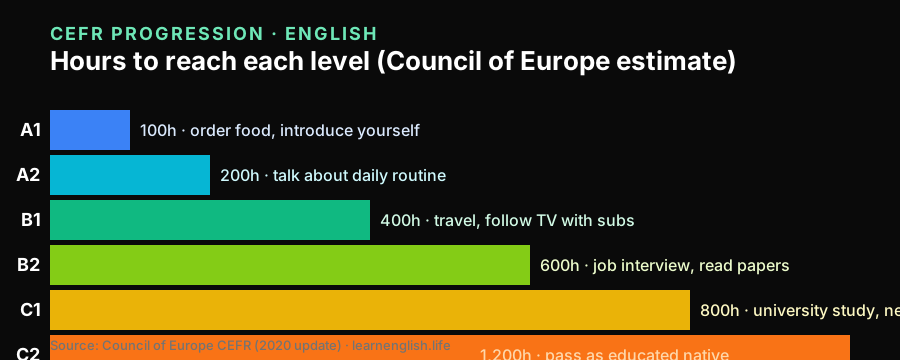
The Common European Framework of Reference for Languages, the CEFR, was published by the Council of Europe in 2001 and has since become the default vocabulary for talking about language ability across Europe and most of the testing world. There are six published levels, A1 through C2, and they are defined not by grammar items you should know but by what you should be able to do with the language.
That last point matters. CEFR is a "can-do" framework. A learner is at B1 when they can do certain things, not when they have ticked certain grammar boxes. This is why a self-assessment that asks "Can you have a 15 minute conversation about your work?" is more honest than one that asks you to identify the past perfect continuous in a multiple choice question.

How to use this guide
Read the can-do statements for each level in order, starting at A1. Be brutally honest. Stop at the first level where you would not confidently say "yes, I can do all of these in real time, with a stranger, without preparing first". The level just below that is your real working level.
Most adult learners overestimate by half a level. If you are unsure between A2 and B1, you are A2. If you are unsure between B1 and B2, you are B1. The reason is simple: you can recognise the higher level when you hear it, but you cannot yet produce it under pressure. Recognition is not production, and CEFR scores production.
You should be able to:
- Introduce yourself: name, country, age, job
- Order food from a picture menu
- Understand prices and times
- Spell your name and email out loud
A sentence at this level sounds like:
Hi. My name is Anna. I am from Poland. I work in a hospital. I like coffee and books.
Red flags that you are not yet here:
You hesitate on simple greetings. You rely heavily on translation in your head before each sentence.
You should be able to:
- Talk about your daily routine and last weekend
- Make a hotel reservation by phone with prepared phrases
- Read a short, clear email about a planned event
- Write a 4 to 6 sentence message to a friend
A sentence at this level sounds like:
Yesterday I went to the cinema with my sister. The film was long but very funny. After that we ate pizza in a small place near the station.
Red flags that you are not yet here:
You can read but freeze when speaking. You confuse past simple and present perfect almost every time.
You should be able to:
- Travel without help in an English-speaking country
- Follow most TV shows with English subtitles
- Hold a 15 minute small-talk conversation with a patient native speaker
- Write a clear paragraph explaining your opinion
A sentence at this level sounds like:
I think working from home suits some people but not others. In my case, I get more done in the morning if I am alone, but I miss talking to my colleagues. The right answer probably depends on the type of work.
Red flags that you are not yet here:
You stumble badly when the topic shifts. Your written and spoken English are at very different levels.
You should be able to:
- Pass a job interview in English for a non-English-language role
- Read a newspaper article without a dictionary
- Argue your side in a debate, including counter-arguments
- Watch a film without subtitles and follow the plot
A sentence at this level sounds like:
The argument that remote work damages company culture has some weight, but it confuses cause with correlation. The teams that already had weak culture are simply more visible now that the chairs are empty.
Red flags that you are not yet here:
You can produce complex sentences but with frequent errors in articles, prepositions or word order.
You should be able to:
- Study at university in English without language support
- Negotiate a contract with attention to nuance
- Use idioms and phrasal verbs naturally, not as decoration
- Detect tone: irony, sarcasm, gentle disagreement, polite refusal
A sentence at this level sounds like:
I take your point about the timeline, but the underlying issue here is not scheduling, it is that we have not agreed on what done looks like. If we settle that now, the deadline takes care of itself.
Red flags that you are not yet here:
Your accent or rhythm gives you away faster than your grammar does. You are still rehearsing complex sentences in your head.
You should be able to:
- Pass for an educated native speaker in writing
- Catch and play with subtle puns and cultural references
- Write academic prose that does not need editing for clarity
- Mediate between two native speakers who are misunderstanding each other
A sentence at this level sounds like:
Whether the policy actually moves the needle is, frankly, beside the point. It was never meant to. It was meant to look like movement, and on that narrow brief, it has succeeded.
Red flags that you are not yet here:
There are basically no language red flags at this level. The constraint becomes domain knowledge, not language.
Why self-assessment beats most online tests
Most free online level tests run 15 to 30 multiple choice questions, mostly on grammar and vocabulary. They produce a confident-looking single letter result and they are wrong about half the time. The reason is that grammar recognition does not predict speaking or writing ability, and most learners have very different levels across the four skills.
A useful placement test mixes a long writing sample, a recorded speaking response, a listening exercise with branching difficulty, and a reading task. That is what Cambridge, the Aptis test, the Pearson PTE and the Council of Europe self-assessment grids are designed to do. None of them takes 5 minutes.
Self-assessment using can-do statements is the next best thing because it forces you to think about what you can actually produce, not what you can recognise on a multiple choice screen.
What to do once you know your level
The single most useful thing about knowing your CEFR level is that it stops you wasting time on material at the wrong level. Most adult learners stall because they study material that is either too easy (input that does not stretch them) or too hard (input that they cannot decode without a dictionary).
The sweet spot, sometimes called "i+1" after the linguist Stephen Krashen, is material where you understand about 90 percent of what you encounter and have to work for the remaining 10 percent. At A2, that is graded readers and short YouTube clips designed for learners. At B2, that is podcasts at normal speed and articles in The Economist or BBC Future.
When you are choosing a tutor, choose one who works regularly with students at your level. A teacher who specialises in C1 candidates preparing for IELTS Speaking band 7+ is wasted on an A2 learner who needs gentle vocabulary expansion, and vice versa.
When you are buying a textbook or course, look for the CEFR level on the cover. Reputable publishers (Cambridge, Pearson, Macmillan, Oxford) label their materials. If a course advertises "for all levels" without further detail, it is almost certainly a marketing line and the material itself drifts somewhere around A2 to B1.
A note on speaking versus writing levels
It is normal, even common, to have different CEFR levels in different skills. Many learners read at B2 and speak at A2 because they have spent years on input and almost no time on output. Some specialist learners (researchers, lawyers) write at C1 and speak at B1 for the same reason in reverse.
Treat your CEFR self-assessment as four separate scores: listening, reading, speaking, writing. Plan your study around the lowest of the four, not the highest. The lowest is the one that limits you in real conversations.
Further reading and sources
- Council of Europe, "Common European Framework of Reference for Languages: Learning, teaching, assessment", 2001 and 2020 update.
- British Council, "How CEFR levels are calibrated", a practical guide for teachers.
- Cambridge English, "Cambridge English Scale" and its mapping to CEFR levels A1 through C2.
- Stephen Krashen, "Principles and Practice in Second Language Acquisition", 1982, on the i+1 input hypothesis.
This article contains no affiliate links. It is a reference page maintained by the editorial team and updated when CEFR descriptors are revised by the Council of Europe.